
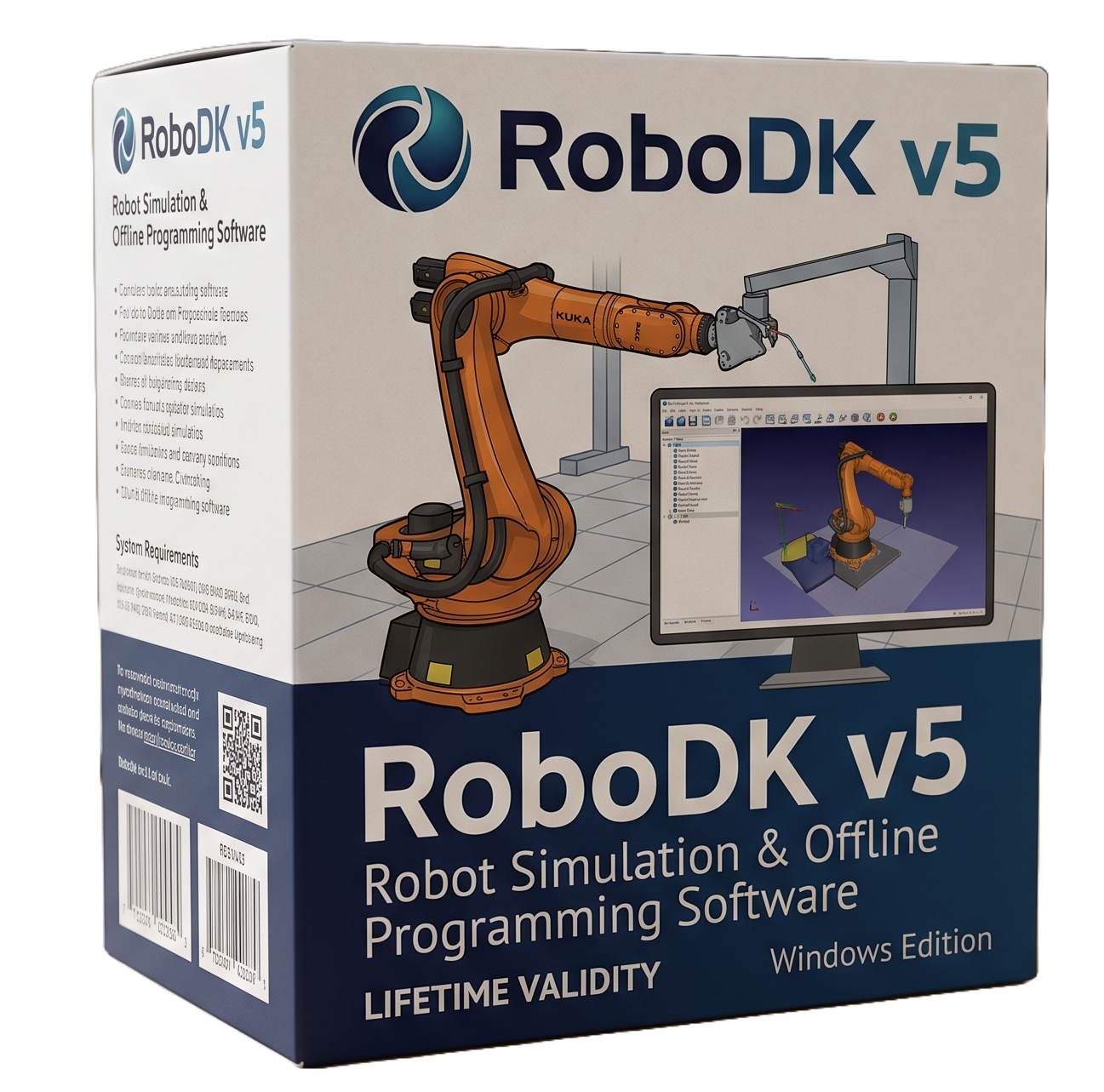
RoboDK v5 for Lifetime
- AUTOMATIC DELIVERY INSTANTLY ON REGISTERED EMAIL .
- Any Installation Problem Freely Contact Us(Will Give You Support)
- Lifetime Validity
- Windows Version
- RoboDK v5 for Windows is professional robot simulation and offline programming software.
- Designed for robotics engineers, automation integrators, manufacturers, and programmers.
- Supports robot simulation, collision detection, reachability analysis, and offline programming.
- Suitable for welding, machining, cutting, painting, inspection, deburring, and material handling.
- Integrates with SOLIDWORKS, Inventor, Fusion 360, Mastercam, Rhino, and Solid Edge.
- Supports hundreds of industrial robot models from major manufacturers.
- Includes Python API, plugins, custom post-processors, external axes, and camera simulation.
- Ideal for industrial robotics, automation, CAD/CAM integration, and robotic manufacturing.
₹550.00
Description
RoboDK v5 for Windows is a robot simulation and offline programming platform designed for industrial robotics, automation engineering, and robotic manufacturing. It allows users to build virtual robot cells, simulate robot motion, check reachability and collisions, generate robot programs, and optimize manufacturing processes without requiring the physical robot to be available during programming. RoboDK supports a broad range of industrial robot manufacturers and can be used for applications such as machining, welding, cutting, painting, inspection, deburring, and material handling.
The software provides a graphical environment for importing robots, tools, workpieces, fixtures, coordinate systems, and other cell components. Users can define TCPs, reference frames, targets, robot programs, and motion sequences, then simulate the complete cell before transferring generated code to a real robot. RoboDK’s post-processors convert simulated programs into controller-specific robot code, making the software useful for multi-brand automation environments.
RoboDK v5 also emphasizes CAD/CAM interoperability. RoboDK 5 introduced or expanded plugins for applications including SOLIDWORKS, Solid Edge, Rhino, Mastercam, Inventor, and Fusion 360, allowing CAD geometry and CAM toolpaths to be incorporated into robotic programming workflows. The platform also supports APIs and plugins for customization and automation, including Python-based programming and interfaces for developing specialized robot workflows.
For simulation and validation, RoboDK includes collision checking, robot kinematics, reachability analysis, cycle-time estimation, camera simulation, external axes, machining workflows, and robot calibration-related capabilities. RoboDK 5.0 also improved graphics performance and introduced GPU-accelerated rendering and more sophisticated camera simulation.
Key Features
• Industrial robot simulation and offline programming
• Virtual robot-cell creation and visualization
• Robot kinematics, positioning, targets, and reference frames
• Collision detection and motion validation
• Robot reachability and workspace analysis
• Automatic robot program generation through post-processors
• Support for hundreds of industrial robot models and numerous manufacturers
• CAD/CAM integration with SOLIDWORKS, Solid Edge, Rhino, Mastercam, Inventor, Fusion 360 and other systems
• Robot machining, milling, drilling, cutting, welding, painting, inspection and deburring workflows
• External axes, rails, positioners and custom mechanisms
• 2D and 3D camera simulation
• Robot calibration and performance-testing options
• Python API for automation and custom programming
• Plugin interface for extending the application
• Custom post-processors for specialized robot controllers
• Robot-driver connectivity for supported hardware
• Import and manipulation of CAD/3D geometry
• Simulation playback and cycle-time analysis
• GPU-accelerated graphics for demanding simulation scenes
• Windows command-line/no-UI operation for automated workflows
• Network licensing and USB-dongle licensing options
What’s New
RoboDK v5.0 — major release
• Up to approximately 2× faster performance on complex projects
• Reduced RAM consumption compared with earlier releases
• Improved graphics rendering and GPU acceleration
• Expanded CAD/CAM plugin ecosystem, including Solid Edge support
• Improved camera simulation with dockable 2D cameras, pixel-size controls and lens-distortion simulation
• Robot Library expanded to more than 500 robots from approximately 50 manufacturers at the time of release
• Expanded support for robot manufacturers including Omron, Techman, FANUC, KUKA, Universal Robots, Panasonic, Dobot, Doosan and uFactory
• Complete plugin interface for deeper application customization
• Expanded API capabilities for automated and customized robot programming
• Japanese language support added to the application
Version note: RoboDK has continued developing beyond the original v5.0 release; the vendor’s current download page now offers RoboDK 6.0. Therefore, “RoboDK v5” is best treated as a specific software generation rather than the current release.
Professional Applications
• Industrial robotics programming
• Robotic CNC machining
• Welding and fabrication automation
• Robotic cutting and trimming
• Automated painting and dispensing
• Pick-and-place and material handling
• Robotic inspection and quality control
• Deburring and surface finishing
• Aerospace and automotive manufacturing
• General manufacturing automation
• Robot-cell feasibility studies
• CAD/CAM-to-robot programming
• Robotics education and research
• Custom automation and system integration
• Robot calibration and production optimization
System Requirements
Minimum Requirements
- OS: Windows 7, Windows 8, Windows 10 or Windows 11, 32-bit or 64-bit according to RoboDK’s published requirements for the v5-era software.
- CPU: Modern x86/x64 processor; RoboDK does not specify a demanding processor minimum.
- RAM: 2 GB minimum.
- Storage: Approximately 15 GB drive capacity, with at least 1 GB free space according to the vendor’s requirements.
- Display: Minimum 1024 × 768 resolution.
- GPU: Graphics driver supporting OpenGL 3.0 or later; hardware-accelerated OpenGL graphics are recommended.
- Input: Two-button mouse minimum; three-button/middle-wheel mouse recommended.
- Internet: Required for activation of network licenses; ports 80 and 443 must be accessible for network licensing.
Related Products
- AUTOMATIC DELIVERY INSTANTLY ON REGISTERED EMAIL .
- Any Installation Problem Freely Contact Us(Will Give You Support)
- Lifetime Validity
- Windows Version
- Route complex PCB traces automatically with the new AI-driven auto-interactive router.
- Collaborate seamlessly with mechanical engineers via the enhanced real-time MCAD CoDesigner.
- Simulate power integrity and signal performance instantly within the unified design environment.
- Manage component shortages proactively with live supply chain data in ActiveBOM.
- Visualize multi-board systems and rigid-flex designs in photorealistic 3D detail.
- Sync all design changes and version history securely to the cloud with Altium 365.
- Define complex high-speed design rules easily using the visual Constraint Manager.
- AUTOMATIC DELIVERY INSTANTLY ON REGISTERED EMAIL .
- Any Installation Problem Freely Contact Us(Will Give You Support)
- Lifetime Validity
- Mac Version
- Run natively on Apple Silicon (M1/M2/M3/M4/M5) for blazing-fast performance.
- Visualize models with realistic depth using the new Ambient Occlusion engine.
- Generate unique textures instantly with integrated AI-powered prompts.
- Sync projects seamlessly between Mac, iPad, and Web versions.
- Convert iPhone LiDAR scans into 3D models automatically via Scan-to-Design.
- Create 2D documentation faster with the optimized LayOut rendering engine.
- Import and export USDZ files easily for Apple AR visualization.
- AUTOMATIC DELIVERY INSTANTLY ON REGISTERED EMAIL .
- Any Installation Problem Freely Contact Us(Will Give You Support)
- Lifetime Validity
- Windows Version
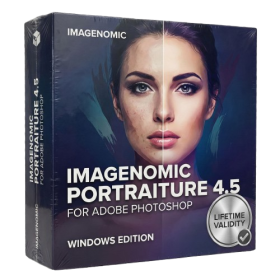
- Smooth skin naturally while preserving texture using advanced AI algorithms.
- Generate precise skin masks automatically to isolate subjects instantly.
- Process massive batches of photos rapidly with optimized multi-core performance.
- Remove blemishes and imperfections without blurring eyelashes or eyebrows.
- Even out skin tones to correct redness and blotchiness effortlessly.
- Apply professional retouching styles quickly with a customizable preset library.
- Fine-tune mask selection manually with the interactive refinement brush.
- AUTOMATIC DELIVERY INSTANTLY ON REGISTERED EMAIL .
- Any Installation Problem Freely Contact Us(Will Give You Support)
- Lifetime Validity
- Windows Version
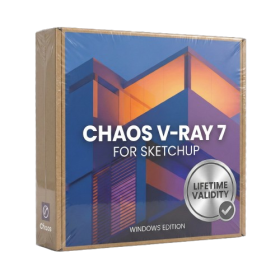
- Chaos V-Ray 7.20.01 for Rhinoceros 7 – 9 & SketchUp 2021 – 2026
- Render real-world 3D scans with reflections using native Gaussian Splatting support.
- Simulate accurate stars, moon phases, and the Milky Way with the procedural Night Sky.
- Upscale renders to 16K resolution instantly with the one-click AI Upscaler.
- Populate vegetation naturally with new Clustering modes in Chaos Scatter.
- Clip and trim Gaussian Splat models directly within the SketchUp viewport.
- Render complex light fixtures significantly faster using optimized V-Ray Luminaires.
- Remove bright noise pixels automatically during rendering with Firefly Removal.
- Add detail to people and grass without re-rendering using the AI Enhancer.
- Lifetime Validity
- Instant Delivery on Email
- Supported on All Apple Mac Systems
- Any Installation Problem Freely Contact Us(Will Give You Support)
- File Size: 6.68GB (20.3.2 Version)
- Ai Features are working
- Works with Internet and Antivirus
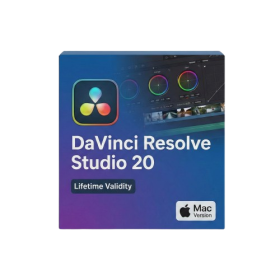
- Edit 12K projects effortlessly with native optimization for Apple M3 and M4 Ultra chips.
- Render renders up to 4x faster using the fully unified memory architecture of Apple Silicon.
- Generate depth maps instantly from single-camera clips using the Apple Neural Engine.
- Grade HDR content with absolute precision on Liquid Retina XDR displays using the new EDR workflow.
- Isolate voices from noisy backgrounds in real-time with the Core ML-powered Voice Isolation.
- Edit spatial video for Apple Vision Pro with a dedicated stereoscopic 3D viewer.
- Track complex objects in 3D space instantly with the Metal-accelerated IntelliTrack AI.
- AUTOMATIC DELIVERY INSTANTLY ON REGISTERED EMAIL .
- Any Installation Problem Freely Contact Us(Will Give You Support)
- Lifetime Validity
- Windows Version
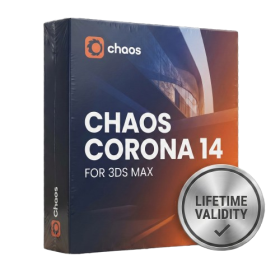
- Render scenes with significantly less noise using the improved High-Quality Denoiser.
- Create intricate procedural clouds and weather effects with the updated Corona Sky.
- Scatter objects efficiently on surfaces with the enhanced Chaos Scatter controls.
- Apply decals to curved and organic surfaces seamlessly without UV unwrap.
- Simulate realistic fabrics and velvets instantly with the new Sheen layer.
- Manage complex scenes easily using the optimized Lister and Scene Management tools.
- Reduce memory usage significantly when rendering repetitive geometry with Corona Pattern.
- AUTOMATIC DELIVERY INSTANTLY ON REGISTERED EMAIL .
- Any Installation Problem Freely Contact Us(Will Give You Support)
- Lifetime Validity
- Windows Version
- Ray trace over 2,200 nature assets including trees and shrubs for realistic reflections.
- Preview renders instantly with the new real-time NRD denoiser in Photo and Movie modes.
- Render ray-traced videos up to 5x faster using the optimized sampling engine.
- Simulate realistic glass refraction and colored shadows with fully ray-traced glass.
- Add depth to translucent materials like marble and wax with Subsurface Scattering.
- Populate interiors instantly using 25+ new parallax room templates for day and night.
- Import GLTF files directly for a lighter and faster 3D model workflow.
- Batch import multiple 3D models simultaneously to speed up scene building.
- Lifetime Validity
- Instant Delivery on Email
- Any Installation Problem Freely Contact Us(Will Give You Support)
- Supported on Windows 10,11
- Pre-Activated for Lifetime Validity
- Supports: Revit 2022 to 2026
- Import and render real-world 3D Gaussian Splats directly within the Revit interface.
- Generate custom PBR textures instantly from text prompts with the AI Material Generator.
- Visualize changes in real-time using the seamless Chaos Vantage Live Link.
- Populate scenes with vegetation and crowds efficiently using Chaos Scatter.
- Edit colors and apply finishing touches directly in the advanced V-Ray Frame Buffer.
- Ensure material consistency across different software with native OpenPBR support.
- Add realistic details like road markings or graffiti using V-Ray Decals.
- Simulate dynamic skies and cloud shadows with the procedural Cloud system.
- Generate dozens of lighting variations automatically with the Light Gen tool.
- Accelerate rendering times significantly with optimized NVIDIA RTX GPU support.
- AUTOMATIC DELIVERY INSTANTLY ON REGISTERED EMAIL .
- Any Installation Problem Freely Contact Us(Will Give You Support)
- Lifetime Validity
- Windows Version
- Online & Offline both working
- Create watertight meshes instantly for 3D printing with the new ShrinkWrap tool.
- Generate dynamic 2D sections and plans directly from 3D models with ClippingDrawings.
- Model organic shapes with greater precision using supported SubD creases.
- Manipulate geometry intuitively with the new customized Auto Gumball.
- Extrude and modify faces instantly using the direct PushPull workflow.
- Render scenes significantly faster with the optimized Cycles engine.
- Customize the modernized interface to match your specific drafting workflow.
- Lifetime Validity
- Instant Delivery on Email
- Any Installation Problem Freely Contact Us(Will Give You Support)
- Supported on Windows 10,11
- File Size: 7.47GB (20.3.2 Version)
- Ai Features are working
- Works with Internet and Antivirus
- Generate complex color grades instantly from text prompts or reference images with AI Match.
- Isolate and remix individual instruments from a stereo music track using Fairlight AI Stem Separation.
- Track objects obscured by smoke or glass perfectly with the new Deep Neural Magic Mask.
- Edit spatial video natively for Apple Vision Pro and Meta Quest with full depth visualization.
- Remove unwanted moving objects from complex backgrounds automatically with Generative Fill for Video.
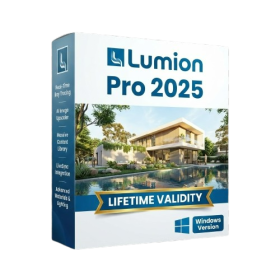
- AUTOMATIC DELIVERY INSTANTLY ON REGISTERED EMAIL .
- Any Installation Problem Freely Contact Us(Will Give You Support)
- Lifetime Validity
- Windows Version
- Hybrid Ray Tracing: Perfect reflections, shadows, and glass instantly.
- LiveSync: Real-time link to Revit, SketchUp, and Rhino.
- Full Library: Over 9,000 assets (trees, cars, people) included.
- Phasing Effect: Animate the construction process easily.
- Real Skies: 60+ HDR skies that light your scene automatically.
- Styles: One-click presets for “Watercolor,” “Sketch,” or “Realistic.”
- 3D Grass: Turn any surface into realistic, volumetric grass.
- Volumetric Spotlights: Create dusty, atmospheric beams of light.
- Material Editor: Add weathering, rounded edges, and foliage to textures.
- Output: Render 8K images, 4K videos, and 360 panoramas.
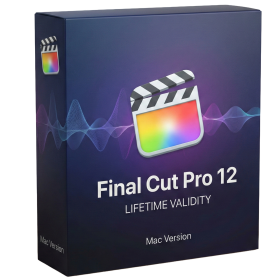
- Lifetime Validity
- Instant Delivery on Email
- Supported on All Apple Mac Systems
- Any Installation Problem Freely Contact Us(Will Give You Support)
- Visual Search: Find clips by describing objects or actions (e.g., “sunset”).
- Beat Detection: Auto-generate markers to sync edits to music beats.
- Transcript Search: Find footage by typing spoken dialogue.
- Magnetic Mask: Isolate subjects instantly without green screens.
- Spatial Video: Edit and grade 3D content for Apple Vision Pro.
- Voice Isolation: Remove background noise with one click.
- Transcribe to Captions: Auto-generate subtitles on-device.
- Smooth Slo-Mo: AI-generated frames for perfect slow motion.